
Pneumatic Mixer (Air Mixer)
The Gentle, Maintenance-Free Solution for Blending Delicate and Ultra-Fine Dry Powders
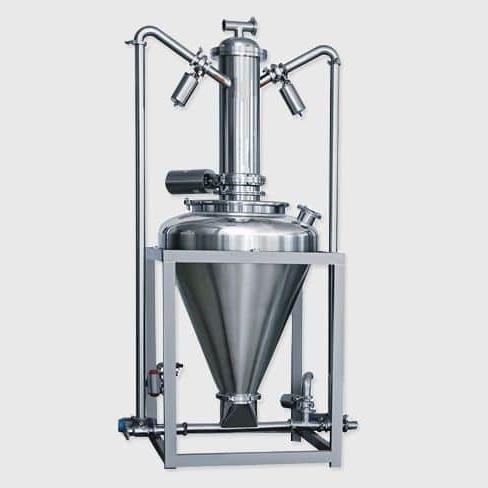
The Pneumatic Mixer, or Air Mixer, is a unique blending system that uses precisely controlled pulses of compressed air to fluidize and mix dry, fine powders. With no internal moving parts, it offers a completely mechanical agitation-free environment, making it ideal for blending ultra-fine, abrasive, heat-sensitive, or fragile materials where traditional mechanical mixers could cause degradation, wear, or contamination.
Key Features
-
Air Fluidization Mixing Principle
Compressed air is introduced through a porous membrane or specially designed nozzles at the vessel bottom, lifting and circulating the powder in a gentle, fluid-like state for homogeneous blending.
-
Zero Mechanical Agitators
The mixing chamber contains no shafts, blades, or seals that contact the product, eliminating dead zones, shear stress, and contamination risks from worn parts.
-
Gentle and Uniform Action
The fluidization process ensures all particles are uniformly suspended and mixed without impact or friction, preserving particle size and structure.
-
Easy and Thorough Cleaning
Simple, smooth internal surfaces with no complex internals allow for rapid, complete cleaning and product changeover, often supporting CIP (Clean-in-Place) systems.
-
Multi-Function Vessel
The same vessel can often be used for mixing, storage, and discharge, streamlining the process layout.
Advantages
-
Ideal for Delicate Materials
Perfect for blending fine, coated, or crystalline powders (e.g., micronutrients, certain additives) without breaking down particles or damaging coatings.
-
Minimal Maintenance & High Reliability
The absence of internal moving parts drastically reduces maintenance costs and downtime associated with bearing failures, shaft seals, or agitator wear.
-
Excellent for Abrasive Powders
Eliminates the severe wear on blades and liners caused by abrasive materials, offering a much longer service life.
-
Hygienic & Contamination-Free
Smooth, crevice-free interior is easy to sanitize and prevents cross-contamination, suitable for high-purity applications.
-
Energy Efficient for Fine Powders
Fluidization mixing can be more energy-efficient than mechanical agitation for specific, hard-to-blend fine powders.
Applicable Raw Materials
-
Ultra-Fine Powdered Additives
Such as micronized sulfur, certain trace element powders (e.g., zinc oxide, copper sulfate), and fine silica.
-
Abrasive Mineral Powders
Fine-grind phosphate rock or other abrasive fillers.
-
Low-Bulk-Density, Fluffy Materials
Certain organic powders or fumed additives.
-
Heat-Sensitive Powders
Materials where mechanical friction could generate unwanted heat.
-
Pre-Mixing for Granulation
Creating a perfectly homogenous dry powder blend before it is fed into a wet granulation process.
Basic Structure & Components
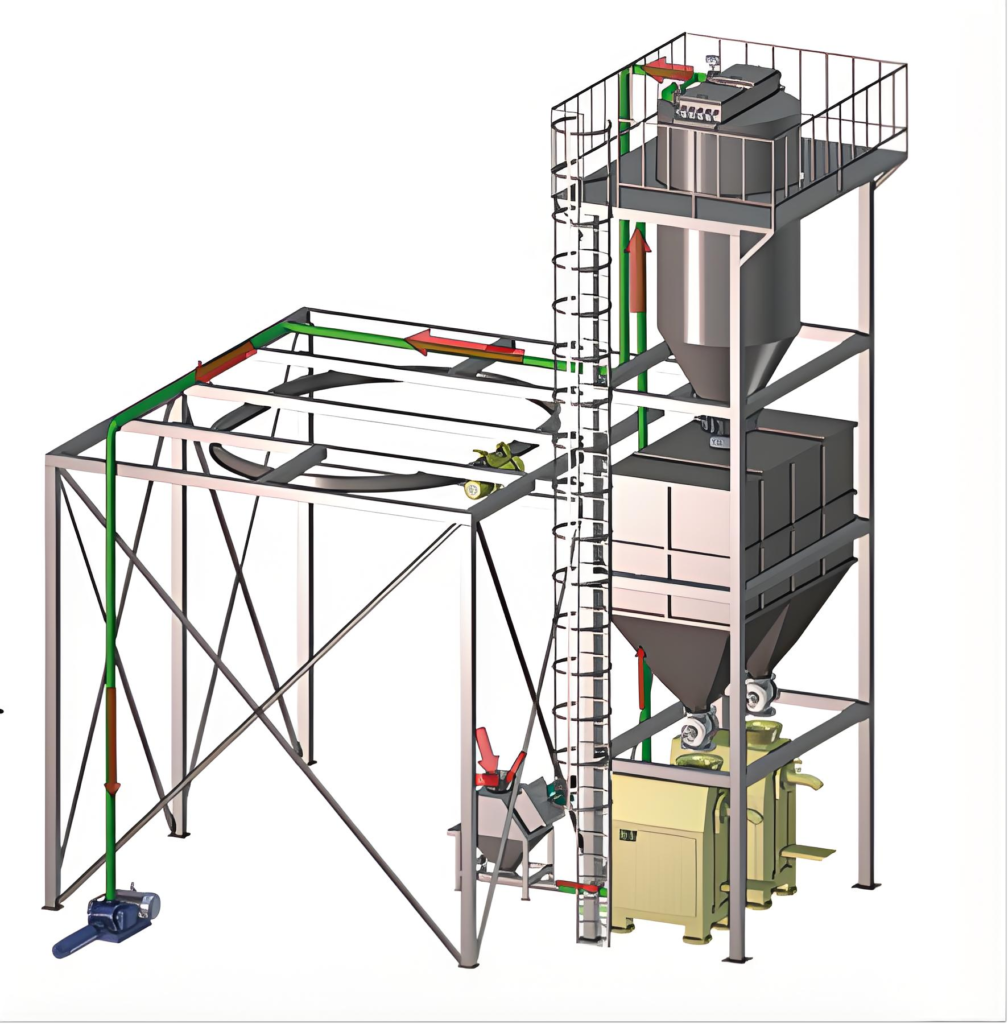
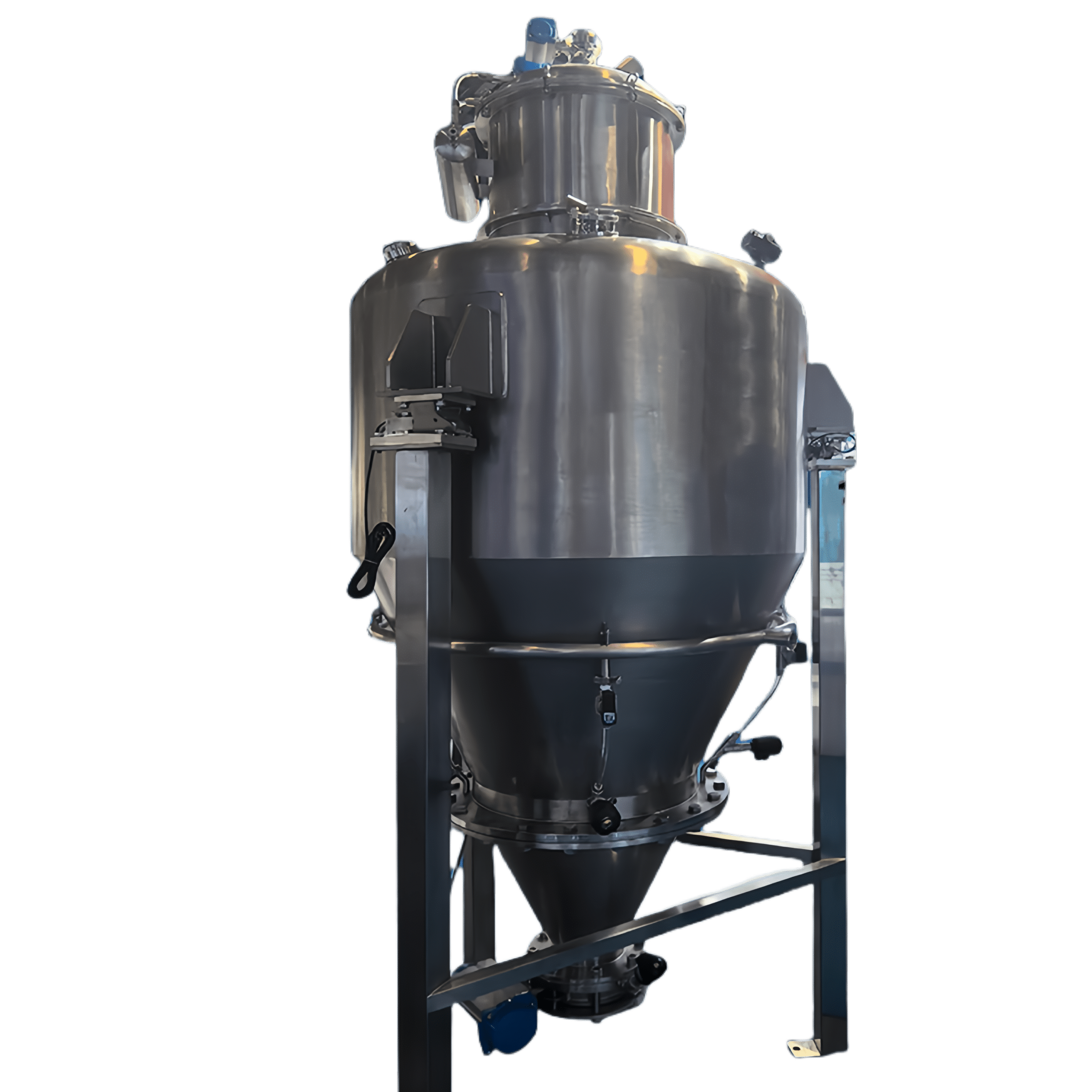
A vertical, cylindrical vessel with a conical or dished bottom, typically made of stainless steel. The bottom houses the fluidization system.
A sintered metal plate, porous ceramic plate, or an array of specialized nozzles that evenly distributes compressed air across the vessel’s cross-section.
Includes an air compressor, air dryer/filter, pressure regulator, solenoid valves, and a programmable timer/controller to manage pulse frequency and duration.
A large-diameter, often inflatable seal or pinch valve at the vessel outlet that provides a full-bore, obstruction-free discharge.
A vent filter (e.g., bag filter) at the top of the vessel to allow air exhaust while retaining powder.
A frame or legs to support the vessel.
For setting and automating the mixing cycle (air pulse sequence).
Technical Data
Parameter | Model PM-2000 | Model PM-5000 | Model PM-10000 |
Total Capacity (L) | 2000 | 5000 | 10000 |
Working Capacity (L) | 1400 – 1600 | 3500 – 4000 | 7000 – 8000 |
Air Consumption (Nm³/min) | 1.0 – 1.5 | 2.0 – 3.0 | 4.0 – 5.5 |
Air Pressure Requirement (bar) | 3 – 6 | 3 – 6 | 3 – 6 |
Mixing Cycle Time (min) | 10 – 20 | 10 – 20 | 10 – 20 |
Discharge Valve Diameter (mm) | 200 | 250 | 300 |
Vessel Height (m, approx.) | ~3.0 | ~4.0 | ~5.0 |
Note: Working capacity depends on material density and fluidization characteristics. Air consumption is intermittent (pulsed). All specifications are for reference and subject to engineering customization. | |||
Key Differentiators vs. Other Mixers
- vs. Horizontal/Vertical Ribbon Mixers
- vs. Twin-Shaft & Vertical Multi-Shaft Mixers
- vs. Simple Drum Roller/Tumbler
- Overall Position
Uses air fluidization instead of mechanical ribbons. This makes it superior for ultra-fine, abrasive, or fragile powders but completely unsuitable for granules or moist materials that cannot be fluidized. Ribbon mixers are more versatile for general granular blending.
These are high-shear mechanical mixers for wet, viscous, or agglomerated materials. The Pneumatic Mixer is exclusively for dry, fine powders and applies zero shear force, serving an entirely different application niche.
Offers much faster and more homogeneous mixing due to active fluidization. Tumbling relies on gravity and is slower, less efficient, and can cause segregation.
It is the specialized, low-maintenance solution for achieving perfect homogeneity in challenging dry powder blends where particle integrity, abrasion, or contamination from mechanical wear are primary concerns. It fills a critical niche in premium powder processing.